

God’s Amazing Honeybee
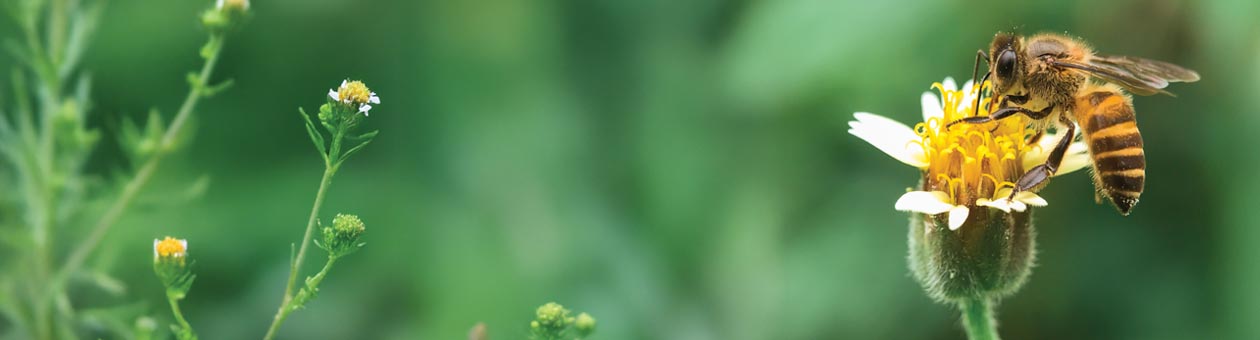
As time progresses, the honeybee charts its course to discover new food sources, such as the tubular vine and the aromatic, beautifully colored honeysuckle. It prepares to return to the hive to perform its famous figure-eight dance, signaling to the worker bees where it has been. These tiny creatures possess a navigation system that guides them back to their hive with remarkable accuracy. They can travel an average of three miles to find pollen, nectar, or water. However, when food sources are scarce, they may extend their search to six miles and still locate their hive with precision. These fascinating creatures are a sight to behold as they shuffle their half-inch black and yellow bodies across the flower’s petals, dipping their proboscis—a long, tube-like structure used to extract nectar—into the flowers as much as they can hold to find their way back home to the hive.
Although the honeybee’s brain is small—comprising just 960,000 neurons compared to the estimated 100 billion neurons in the human brain—it can still accomplish remarkable feats that captivate and draw considerable attention, as evidenced by the hundreds of thousands of beekeepers around the world. These fascinating creatures are classified as eusocial, making them among the most socially organized beings known to humankind.
A single hive can house up to 50,000 bees, which is sufficient to meet agricultural needs while also producing honey, a well-known and beneficial food product for human consumption. Bees are among the most prolific creatures on Earth and play a vital role in the planet’s ecosystem. According to the Center for Food Safety, “In fact, without these species, 70% of plants would be unable to reproduce or produce food.”
Remarkable Biomolecules
Upon discovering a new food source, the worker honeybee hovers over it, noting its position relative to the sun and the time of day. These tiny flying machines also remember the flower’s scent, using their antennae to distinguish it from others. These antennae serve as essential sensory organs for insects. Like many animals, especially insects, honeybees secrete pheromones from their glands, unique chemical substances that mark their path back to the hive.
Pheromones are specialized biomolecules that influence the behavior or functions of animals and insects. They act like hormones, driving significant changes within organisms. While hormones operate internally, pheromones are released externally and affect the behavior of others within the same species. Extensive scientific research has concluded that humans do not produce pheromones.
Honeybees rely on pheromones for many essential behaviors that sustain their life cycles.
They are classified as social insects, alongside species such as ants, termites, and several species of bees and wasps. Social insects depend on pheromones to guide their highly cooperative and complex lifestyles, particularly in honeybee communities. These insects take on specific roles within a caste system, starting with a dominant queen who manages the colony through her pheromones. She emits them like perfume, influencing the behavior of tens of thousands of bees. The queen is primarily responsible for laying fertilized eggs, but her pheromones also regulate whether a male bee, known as a drone, can mate. The queen’s pheromones control the female bees, inhibiting the development of their ovaries, which causes them to become worker bees, smaller than the queen and drones. The queen’s pheromones primarily regulate the workers, directing them to maintain the hive, feed the young, groom her, and manage swarming. There is only one queen bee per colony, who not only controls but also populates the entire hive.
Furthermore, throughout the bee’s body, various glands produce different kinds of essential pheromones for its survival. For example, a pheromone is secreted when a bee stings an enemy, attracting other bees to the location in attack mode, ready to sacrifice themselves to protect the colony. These bees become highly agitated, and, like kamikaze pilots, they attack their enemy with their stinger, leaving it behind and fatally wounding the target. This is one of the reasons why beekeepers use smoke to subdue the pheromone.
The young emit a unique pheromone that signals nursing bees to provide them with a specialized diet for rapid growth. A different pheromone maintains a balance between the bees nursing the young and those foraging for food. Like ants, honeybees leave detectable pheromones to guide others. These social creatures are guided by complex biomolecules that maintain order and help them thrive in the web of life.
Complex Behavior
One of the most intriguing behaviors of honeybees is their waggle dance, which no other creature possesses. When a bee returns to the colony with news of a food source, it waggles its abdomen in a figure-eight pattern, causing the hive to vibrate. This dance indicates the direction of the food source, using the sun as a reference point. Honeybees’ eyes can detect ultraviolet light, even on cloudy days or nights. Additionally, researchers have concluded that the duration of the waggle indicates the distance to the food source. The honeybee can also communicate with other workers by wagging its abdomen more intensely, signaling whether the nectar supply will be abundant. As the bee moves within the hive, it also carries the scent of the nectar, which other worker bees can recognize. Different dances convey various messages, and ongoing research reveals the complexity of communication among these remarkable creatures.
The cliché “busy bee” refers to a diligent worker who is on task, dedicated, and never resting. Bees are everywhere, moving in many directions. The younger workers become master builders, using much of their energy to produce wax from glands located on their lower abdomen to construct hexagon-shaped cells. These six-sided structures maximize capacity, making them both resilient and easy to build. These busy workers never stop and rely on quality nutrition, which they receive from the hive.
One of the most vital functions of the hive is the nursery, which requires many worker bees to produce new bees. Many insects undergo complete metamorphosis, marked by significant anatomical changes in three stages: egg to larva, larva to pupa, and pupa to adult.
The honeybee experiences this process within the cells of the hive. Inside each cell is a small, pearl-like egg measuring 1.5 mm. Within three days, the egg develops into a grub-like, white larva that consumes large amounts of high-protein food known as Royal Jelly. The nursing bees feed the larva for over seven days, during which it grows at an astonishing rate of 1,500 times its size, undergoing six molts. It then forms a pupa by wrapping itself in a cocoon. After eleven days, it emerges as an adult, ready to perform its designated tasks. Metamorphosis is directed by complex biochemical processes that are still under extensive study. Honeybees, as highly complex social creatures, orchestrate this remarkable process in the darkness of the hive, an achievement that should not be overlooked.
These tiny creatures remind us that life is profoundly bewildering and can only come from the hands of the Divine Creator. As time moves forward on this earth, we are privileged to witness brief glimpses of our Creator at work in exquisite details that bear His almighty signature. We fall to our knees, singing GLORY TO THE KING!

