


The Verdict of the Evidence
The Case for a Creator
by Tom DeRosa
Crime scene evidence is extremely important. A skilled detective can use fingerprints, DNA, clothing fibers, and other clues to reconstruct what happened in the past and identify the person responsible. Evidence, when carefully examined, leads to conclusions.
In much the same way, scientists study the evidence found throughout nature to answer one of humanity’s greatest questions:
Does God really exist?
As Ken Ham writes in his new book, Defending God’s Existence, this question carries massive implications because it affects how we understand meaning, morality, life, and even our own purpose.
The origins debate ultimately comes down to evidence and interpretation. The evidence leads to one of two conclusions: evolution or creation. These two basic views are completely at odds and admit no middle ground. On the one hand, evolution relies on random chance as the agent by which matter and energy, over time, assembled into living systems with extraordinary complexity. The evolutionary process, we are told, requires billions and billions of years. Creation, by contrast, relies on an outside intelligence which we define as the Creator, the One who made from nothing a universe exhibiting order and design. Vast stretches of time are not needed for creation.
The origins debate is much like a detective investigation. No human being was present to observe the beginning of life or the formation of the universe. Scientists must examine the evidence left behind and draw conclusions about the past.
The same evidence can lead to very different conclusions. Why? Because evidence is interpreted through one’s worldview and presuppositions.
Worldviews at War
The creation versus evolution debate is not over the evidence itself, but over how that evidence is interpreted. A fossilized dinosaur bone, for example, may be interpreted by the evolutionist as evidence of millions of years of gradual change, while the creationist may understand it as evidence connected to catastrophic events such as the worldwide Flood described in Genesis.
Those who begin with naturalistic assumptions will reach very different conclusions than those who begin with the Word of God as the foundation for understanding the origin of life and the universe. God’s Word is truth and gives light to our understanding. As the psalmist declared, “Your word is a lamp to my feet and a light to my path” (Psalm 119:105).
This conflict of worldviews has existed for a long time, but it intensified in the nineteenth century after Charles Darwin published Origin of Species. Darwinian evolution gradually spread throughout Western culture and eventually became widely accepted in education, science, and the media.
Many people believe Darwin discovered evolution. In reality, its roots can be traced to the prehistoric confrontation between men and their Creator. According to Henry Morris, a scientist and author widely considered to be the father of the modern creation movement, Darwin happened along at the right historical moment to spark a movement that was really just the renewal of an ancient idea:
The fact is, however, he really only served as the catalyst for revival of ancient paganism, coming at just the right time in history to bring to fruition a revolt against God for which many in Western Europe had been preparing for over a century.
A worldview may be defined as a framework for understanding reality. It is the set of core beliefs through which knowledge is interpreted, decisions are made, values established, and priorities set. Every human being, young or old, has within himself a worldview. It is nurtured in childhood and adolescence and grows ever more deeply ingrained with age. Worldviews can, however, dramatically change as, for example, when an individual is born again and becomes, as the Bible puts it, “a new creature in Christ.” Those who encounter Christ and commit themselves to the Word of God experience a transformation that often radically alters their worldview.
A creationist worldview starts with belief in God, the Creator of all things. It is centered on the inspired Word of God that provides an account of the beginning of the universe and of man. It also supplies an early history of the world in the first eleven chapters of Genesis. It characterizes creation as “very good” in Genesis 1. In Genesis 3 it describes the Fall of man and the ramifications that are observed in a world placed under God’s curse.
Genesis records a great judgment in chapter 6, the worldwide flood that produces effects that influence the way the world appears today. The establishment of different nations with unique languages and cultures is recorded in Genesis 10–11. The events recorded in Genesis 1–11 form the creationist worldview and demonstrate man’s accountability to his Creator.
The evolutionist worldview, by contrast, seeks to explain the universe apart from God, attributing life and its diversity to natural processes acting over vast periods of time. It generally views man as the product of nature rather than a fallen creature accountable to his Creator. The Christian worldview, however, recognizes God as the source of truth and moral absolutes, which are rooted in His unchanging character.
Is Science Compatible with the Bible?
Science plays an important role in our everyday lives. Through observation, testing, and investigation, science helps us understand the world around us. Both creationists and evolutionists use scientific tools to study rocks, fossils, DNA, and the universe itself.
But science is not a worldview. Science observes the natural world, while worldviews shape how that evidence is interpreted.
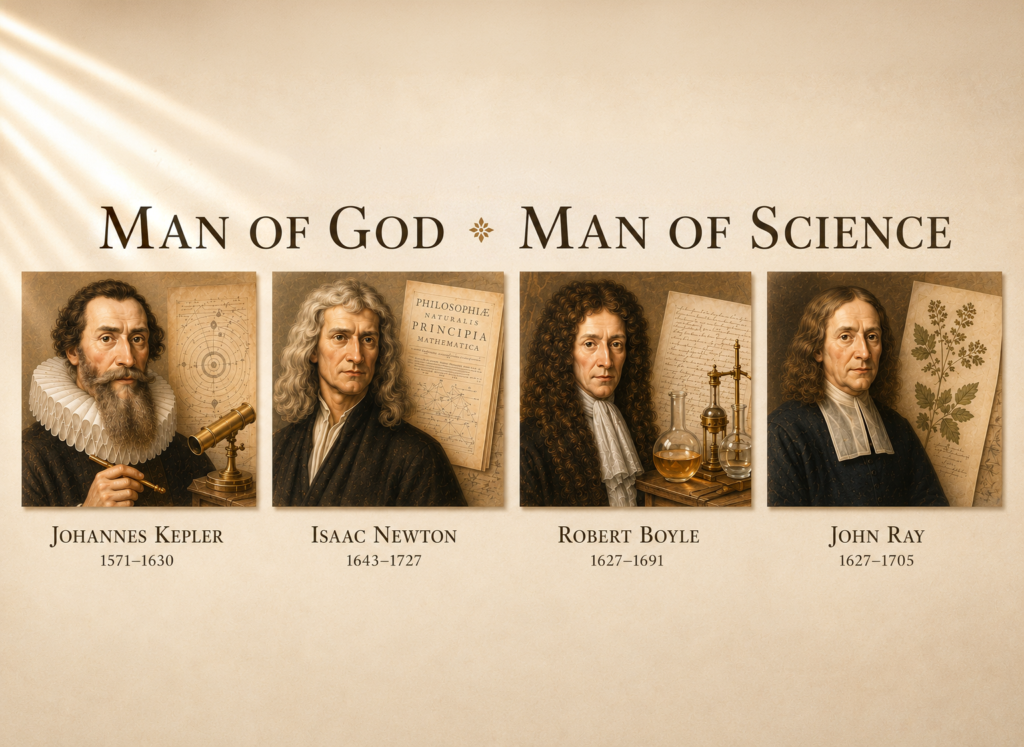
The Christian understands that true science and the Bible are not enemies. In fact, many of the founders of modern science believed the universe reflected the order and wisdom of the Creator. Creation reveals God’s handiwork and power, and Scripture encourages us to study His works. As Psalm 111:2 declares, “Great are the works of the Lord, studied by all who delight in them.”
From the beginning, God called His creation “good,” and mankind was given the responsibility to exercise dominion over the earth (Genesis 1:28). Early scientists understood that investigating the natural world was not contrary to faith, but a way of glorifying the Creator.
History provides many examples of scientists whose faith in God inspired their study of creation.
Johannes Kepler (1571–1630), famous for his work on planetary motion, gave thanks to God for allowing him to study creation. Isaac Newton (1643–1727), one of history’s greatest scientists, believed that the universe reflected the order and power of God. Robert Boyle (1627–1691), often called the father of physical chemistry, viewed creation as a finely tuned design operating according to the Creator’s purpose. John Ray (1627–1705), a botanist and early naturalist, was inspired by Genesis 1 and the biblical teaching that living things reproduce according to their kinds. He argued that the complexity and design of living things point to an intelligent Creator.
Follow the Evidence with an Open Mind
Many who approached the evidence with an open mind began to question the worldview of naturalism. Whether studying the complexity of life or the vastness of the universe, they found evidence of order and design. Following the evidence led many to challenge the claims of evolution and consider the reality of a Creator.
Scripture declares that the evidence for God in creation is plain and clearly seen. As Paul writes in Romans 1, God’s eternal power and divine nature are revealed through the things He has made, leaving mankind without excuse. Yet the evidence should lead us to more than the conclusion that God exists. It should lead us to the One who created all things. The Apostle John begins his Gospel with the same words that open Genesis: “In the beginning.” He then reveals that the eternal Word who created all things became flesh and dwelt among us. Jesus Christ is not only our Creator, but also our Savior.
As Ken Ham reminds us in Defending God’s Existence, our goal is not merely to gain knowledge or win arguments. Rather, it is to “better defend the existence of our Savior, Jesus Christ, to a world that desperately needs to know that He is who He says He is: the eternal God who alone can save.”
Ultimately, the Gospel must remain front and center. While evidence and apologetics can help remove obstacles and challenge false worldviews, they cannot save. The Gospel of Jesus Christ is of utmost importance because it is the power of God unto salvation. The greatest need of every person is not simply to acknowledge a Creator, but to repent and place their faith in Christ, who died for our sins and rose again.
The evidence of creation should lead us not only to recognize God as Maker, but also to know Jesus Christ as Savior, the life and light of the world.
In Christ,
Tom DeRosa Executive Director of Creation Studies Institute, an outreach of CRM

