


It was Created to be Inhabited
For thus says the LORD, Who created the heavens, Who is God, Who formed the earth and made it, Who has established it, Who did not create it in vain, Who formed it to be inhabited: “I am the LORD, and there is no other.”—Isaiah 45:18
Not many realize the uniqueness of Earth and how it is superbly designed to support life. There is a remarkable relationship between the sun and the Earth, whereby dangerous solar radiation is efficiently filtered out, allowing only the radiation necessary for living processes to enter. The Earth and sun exist within a vast cosmos, perfectly positioned to sustain all living forms with their fragility and profound complexity. It is not just what you see that reveals the synchrony and harmony in the operation of life, but also what you do not see.
In the biomolecular world, we observe a plan of action in the form of DNA, executed by specially designed proteins that work together to allow life to exist. Supported by carbohydrates and fats for energy, uniquely crafted phospholipids serve as gatekeepers, providing the basic unit of life, a cell, with distinction and functionality. This beautifully arranged unit in every living organism must be energized to utilize resources like the sun’s rays in photosynthesis and oxygen, which sustain more specialized organisms like you and me. The magnificence of Earth’s design to accommodate life in all forms, along with its dependency on the sun, is a miracle that its inhabitants can witness. The wide breadth of biodiversity, encompassing countless types of organisms too numerous to count, makes Earth a home for various creatures, from microbes to giant sauropod dinosaurs weighing up to 80 tons and standing four stories tall.
Earth is filled with an array of living organisms, including fungi, plants, and animals, all functioning together in complex ecosystems to sustain life. This is astonishing, making it statistically unlikely that another Earth-like planet exists in the cosmos. However, many hopeful evolutionists defy logic and believe such a planet exists in the cosmos. Without the sun, there is no energy; without energy, there is no life. The Earth is, on average, 93 million miles from the sun, which is considered the habitable zone where the surface temperature can support liquid water. The sun is a G-type main-sequence star that is the right type for the Earth. It is 90% brighter and 92% more massive than the average star in the Milky Way Galaxy. Most importantly, the sun is a stable star with a consistent temperature and no evidence of superflares. Its surface is active and sometimes produces flares that extend outward, accompanied by high-energy gamma rays. However, these are relatively mild.
A superflare is a solar flare multiplied by about ten thousand times, reaching deep into the solar system and capable of devastating all life on Earth. Some stars similar to the sun experience such events approximately once every hundred years. Astronomers do not know why the Earth is not affected by superflares. Like our planet, the sun is unique in its dependable energy output and its unusual lack of danger to life on Earth. The sun, a burning star, provides the necessary life-giving energy and much more than what is needed for the third planet in the solar system. Every second in the sun’s core, about 700 million tons of hydrogen are converted into approximately 695 million tons of helium, resulting in a loss of 5 million tons of mass that transforms into radiant energy equivalent to 2 billion 50-megaton hydrogen bombs exploding.
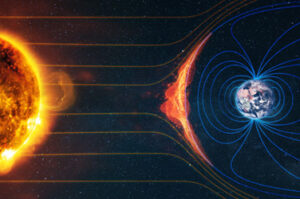
The Earth’s atmosphere surrounding our planet must be uniquely designed to utilize the sun’s massive energy to sustain life. As we observe its composition, it becomes clear that the essential factors for life are present, containing a favorable mix of nitrogen (78%) and oxygen (21%). This combination of crucial gases in our atmosphere ensures that the non-reactive nitrogen molecules blanket the reactive oxygen molecules, keeping Earth’s atmosphere stable. Nitrogen stabilizes the air and is essential for life, as it’s a key component of proteins found in all living organisms. It exists in various forms in soil, supports microbial activity, and plays a role in recycling waste through decomposition.
Oxygen is a reactive element in the Earth’s atmosphere that can be safely distributed to complex biological organisms. It is essential for providing energy to numerous organisms, including mammals and microbes such as amoebas. Through respiration, oxygen supplies energy for all biological organisms, both large and small. Warm-blooded mammals utilize a significant percentage of oxygen to meet their energy needs, as seen in humans, who obtain 90% of their energy through inhalation. The levels of atmospheric oxygen are sensitive to changes. Even a 2.5% increase in oxygen levels could cause forest fires to grow exponentially, along with many other combustible natural and manmade materials. This scenario would make the Earth a perilous place to live. If oxygen levels drop below 1.5%, it becomes dangerous for humans, with early signs of hypoxia appearing.
Another necessary condition for complex living organisms to sustain themselves is water. Water is essential for all life forms. From outer space, it is evident that this planet’s surface is predominantly covered by water, a unique characteristic with 70% of H2O in liquid form that is difficult to find elsewhere in the observable universe. The molecular structure of water is chemically distinctive, featuring an acute angle of 104.5 degrees between the two hydrogen atoms, which makes it polar and contributes to its remarkable ability to attract metals, salts, and many other polar molecules. Water is a highly stable molecule that can be recycled through the hydrological cycle. Water is an ideal medium for transporting nutrients and other critical elements throughout the organism to their desired locations—it’s no wonder that all kinds of life flourish in this watery ocean matrix. The atmosphere remarkably allows lightwave radiation from the sun to react with chlorophyll in photosynthesis.

Another interesting factor about photosynthesis is that the rotation of the Earth is at an optimal speed with light and darkness, providing balance for plant growth. The Earth’s surface would be inhospitable if its atmosphere did not block infrared radiation. The composition of the atmosphere absorbs much of the infrared, making the surface cooler and more livable. As the atmosphere warms up, it becomes more humid due to water vapor, one of the key factors enabling this planet to receive its necessary water supply through the hydrological cycle. In light of these conditions and others that make our planet uniquely special in the universe, Michael Denton, a biologist and a nonbeliever, reached this conclusion:
“All together, these coincidences convey an overwhelming impression of design. The improbability that they are the outcome of the blind concourse of atoms is equivalent to the improbability of drawing the same card twice from a stack of 1025 cards (1 with 25 zeros) stretching from Earth to the Andromeda Galaxy. How else can we describe these coincidences except as miracles of fortuity?”1
Many other conditions that make this planet a special place in the universe can be discussed, but we are limited in space here. Those who believe in God can easily distinguish that the one who created the universe from nothing can make an extraordinary place for us, which we call home. This exemplifies what He has in store for us when we reach our eternal home with Him, as it states in Revelation 21:23:
“The city had no need of the sun or of the moon to shine in it, for the glory of God illuminated it. The Lamb is its light.”
References
1. Denton, Michael. Children of Light: The Astonishing Properties of Sunlight That Make Us Possible (Privileged Species Series) (p. 64).

