

The Root of Logical Thinking – the Word of God
If modern science has its roots in the Bible, why is it not being taught in our schools? Is science compatible with God’s Word? What is truth, and can science uncover it? These questions must be addressed in America and around the world because there is much confusion and a hostile effort to remove God from our lives.
Classical science began with ancient Greek philosophers, particularly Aristotle (384-322 BC), who was one of the first to introduce the study of natural science, especially in biology, physics, and astronomy. The ancient Greek philosophers believed that the universe was composed of four fundamental elements: earth, water, air, and fire. They believed that an eternal fire sustained the celestial bodies.
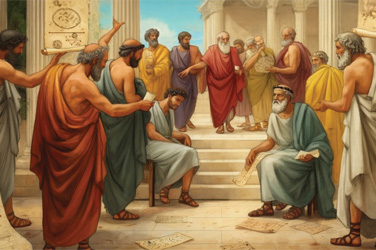
During this time, the Greeks observed that the patterns and movements of heavenly bodies were constant and unchanging which were considered perfect in nature. They regarded these bodies as “incorruptible” and endowed with a divine aspect, supported by an everlasting soul, which reinforced Greek polytheism and mythology.
Aristotle is best remembered for establishing a logical framework for understanding the world and its functions by laying down the laws of reasoning. He introduced deductive reasoning, a method that encourages careful observation and supports assumptions leading to logical conclusions. However, its broad generalizations led to limitations, such as the belief that fire, earth, air, and water could transform into one another. The ancient Greek methods were self-serving, as they believed that humans could comprehend the world by forming ideas based on their own inerrant yet flawed nature. Aristotle’s deductive method, by its very nature, could easily lead to errors, as demonstrated by his views on the fundamental laws of gravity, the forces that keep celestial bodies moving harmoniously in the vast universe. He proposed that objects seek their natural places, which he observed in flames burning upward, while water in a waterfall flows downward to reach its natural position at the Earth’s center. Based on this theory, Aristotle mistakenly concluded that heavier objects fall faster than lighter ones.
Galileo Galilei (1564–1642)
Nearly two thousand years later, Italian physicist, astronomer, and inventor Galileo Galilei dramatically disproved Aristotle’s theory through extensive experimentation and mathematical analysis. It is said that while teaching at the University of Pisa, he dropped objects from the Leaning Tower of Pisa and found that they fell at the same rate, demonstrating that Earth’s gravitational force acts uniformly on all objects. This contradicted the ancient Greek idea of a “natural place,” instead revealing that invisible forces interact with objects.

Galileo was a pivotal figure in the emergence of the modern science movement, emphasizing experimental science, data collection, hypothesis formation, data sharing, and collaboration among scientists. With a deep passion for mathematics and experimentation, he developed classical physics to explain motion, forces, gravity, and projectile motion.
His creativity and engineering skills led to the invention of the thermoscope, which contributed to the development of the thermometer and military compasses. He also made significant enhancements to the telescope, enabling the discovery of distant celestial objects and providing a clearer understanding of the workings of heavenly bodies, thus earning him the title “Father of Observational Astronomy.” Galileo discovered many more stars with his telescope than the ancient Greeks had recorded through their unaided observations. Notably, when he witnessed Kepler’s Supernova in 1604, an exploding star, it revealed significant flaws in the ancient Greeks’ belief in the unchanging nature of the heavens.
Galileo viewed the universe as a dynamic place where God the Creator could be found, as he stated, “God is known by nature in His works, and by doctrine in His revealed Word.”
After the Renaissance began in the 14th century, a revival spread from Italy and beyond, leading to an awakening of intellectual pursuits. People began seeking knowledge about the world through classical art, literature, and science. In the 15th century, the Great Reformation broke the chains of the church’s traditional teachings that salvation was achieved through man’s hard work and various other means, such as the misuse of indulgences to obtain forgiveness from sin. During this period, a significant theological movement emerged, promoting spiritual renewal and emphasizing that salvation is a gift from God. It is through God’s grace that humanity is renewed, not through individual works. This brought people closer to God, underscoring the importance of making God’s Word more accessible to everyone.
Francis Bacon (1561-1626)
Francis Bacon, a lawyer, statesman, and natural philosopher, devoted himself to the experimental method to uncover worlds that had never been seen before. During this period of reformation and the rise of the modern scientific movement, he was dedicated to a personal God who created him in His image and whom he sought to glorify by exploring His creation. He believed in the Genesis account of six days of Creation and that the Word of God governs it. By diligently examining, probing, and studying creation, he felt mankind would be greatly blessed, as shown by our advancements in technology, medicine, and abundant resources. Creation displayed extraordinary order and beauty, crafted by an intelligent, ever-present, and all-powerful Creator. Bacon asserted that creation should be thoroughly investigated, starting with its intricate components, so that God’s grand design could be comprehended.
Bacon employed the dependable process of inductive reasoning, which evolved into the scientific method, focusing on examining individual components and working upward to understand the concept. This method reduces bias and involves thorough observations, experiments, inquiries, data collection, analysis, hypothesis formation, and careful conclusions. He outlined his process in The Advancement of Learning (1623). This method is crucial for understanding how all living and nonliving things function with immense complexity, working together to allow us to live harmoniously on this planet. It illustrates how scientists collaborate and consult with one another and is an essential aspect of scientific advancement.
In stark contrast to the ancient Greeks’ detached approach, Bacon’s inductive method emphasized the importance of investigation, experimentation, and active engagement with the world. It’s no wonder that Francis Bacon is considered the Father of Modern Science. His scientific principles are evident today in the dynamic macro and micro worlds, both living and nonliving, and are reflected in the various fields of modern science, which are rich in complexity and understanding that approaches infinity.
Many Christians, inspired by their faith, pioneered scientific exploration using Bacon’s inductive method. Robert Boyle advanced chemistry beyond alchemy, Nicolas Steno founded stratigraphy with his laws of superposition, and Isaac Newton revolutionized physics with his laws of motion and gravity.
Newton, a brilliant scientist, devoted his later years to studying the Bible, writing, “I have a fundamental belief in the Bible as the Word of God, written by those who were inspired. I study the Bible daily.”
Numerous examples exist of great scientists who adhered to the scientific method while believing in the Word of God as truth. It is ironic that today, one cannot mention Creation or make any connection to the Bible in public schools. Science education should ideally be based on the understanding that, as we gain more knowledge about this Earth and its surroundings, fulfilling God’s dominion mandate, we grow closer to grasping the qualities of the Almighty Creator as revealed in His creation, as affirmed in Romans 1:20. Science serves merely as a tool to seek the truth, which can only be found in Christ.
As we draw nearer to Christ, we approach the truth of the power that sets us free. John 1:14 states, “Jesus said to him, ‘I am the way, and the truth, and the life. No one comes to the Father except through me.’”

