


Raymond Dart: Famous Human Evolutionist or Renowned Storyteller
By Tom DeRosa, Executive Director of CSI.
With unwavering dedication, Carl Werner, a biologist, and Physician, and his award-winning film crew embarked on a mission to expose the truth behind at least 150 ape-man frauds. They traversed 175,000 miles across five continents, visited prominent national museums, interviewed leading human evolutionists, and meticulously documented their findings, including the original ape-man fossils. Their exhaustive research revealed that fraudulent behavior was not an isolated incident but a widespread issue instigated by more than a dozen top scientists from prestigious national museums and universities.

It was a profound shock to the scientific community that one of the most renowned human evolutionists, Raymond Dart, famous for discovering the Taung Child skull in 1924, was a fabricator of the truth. His claims, once held in high regard, were now under scrutiny, revealing a different, unsettling narrative. When he unearthed the child’s skull in a South African cave, he published it in Nature, a prestigious scientific journal, in February 1925. He boldly declared this as a missing link between man and ape, naming a new species, Australopithecus Africanus, the southern ape of South Africa. However, his claim was met with skepticism, setting the stage for a controversial debate on human evolution.
Dart’s claim was met with much skepticism at first, as many experts did not accept it due to its predominantly ape-like features. Two decades later, however, Dart’s Taung Child skull would be accepted because adult skulls were discovered at different South African sites by human evolutionists who assumed adult skulls had similar features to the Taung Child and were classified in the same category as Australopithecus Africanis, dating 2.3 million years old. Even though Taung Child’s skull was accepted, it is still controversial among the ape-man evolutionary scholars. Human evolutionists are biased towards making this child fossil more human than ape, but most observers would conclude that it was some extinct ape. The most annoying fact that is ignored is that the cave Dart discovered the skull is dated 870,000 years ago, much younger than the supposedly 2.3-million-year-old fossils.
Carl Werner and his team exposed hidden facts at another dig site, which gave new insights into Raymond Dart’s role in human evolution. He made many mistakes in the field of human paleontology that would leave much doubt about being a credible evolutionary scientist. In 1945, a blacked bone was found at Makapansgat Cave, which was identified as the MLD site, 200 miles from where the Taung Child was found. Dart believed that the blackened bone was evidence of fire used for cooking and indicated advanced behavior for the Australopithecines, the class ape-man that Taung child has its origins. His student Philip Tobias and a protégé of Dart discovered baboon skulls and hoofed animals in the same cave. There was one Baboon skull that Dart studied and concluded could be another ape-man kind, which he wrote a paper on naming a new species called Australopithecus Prometheus. After he mailed his paper to be published, he suddenly realized there was a mistake in his research and that what he was calling a new species of ape-man was another baboon. He was able to retrieve it before publication and saved himself much ridicule.
Unfortunately, this time, Raymond Dart could not save himself at the MLD site. Two years later, Dart returned to the MLD cave and brought more than 40 bones embedded in the rock, which he termed Australopithecus Prometheus again. This time, he had a degree of certainty because he claimed that these bones were humankind with a large brain. Werner and the film crew exposed significant errors, including misidentifying human fossils that must be written about and kept as hidden evolution ape-man secrets.
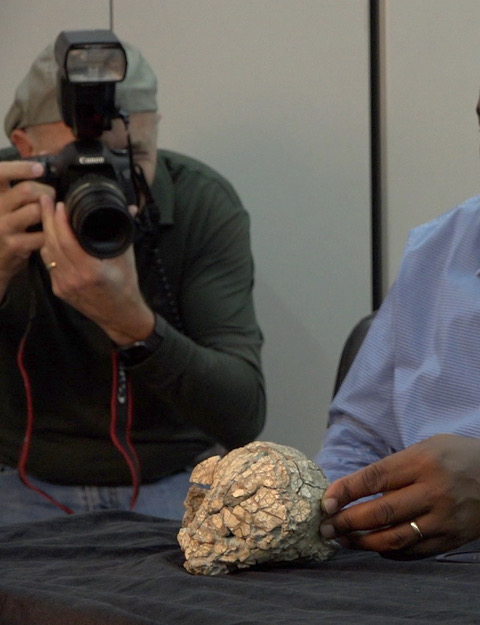
Werner’s team uncovered that the so-called shoulder bones were not human but horse foot bones. The human skull bones found were from various animals, including a small monkey and a bovid. The arm bones were from a baboon. The hip bones were from a large cat. Dart constructed this ape-man from ten different animals that were not even primates. He also identified over 14,000 ape-man specialized stones and hundreds of bone tools without credibility. The discovery of the darkened bones was not from the fire that Dart claimed but was stained from manganese dioxide from the soil. This includes Dart’s assertion of Australopithecus Prometheus on the MLD site.
Perhaps the worst fraud was Dart’s use of his imagination to embellish whatever made a good story without any scientific evidence. With enthusiastic confidence, he gave his Australopithecus Prometheus, termed Australopithecines, sophistic savage behavior. Being an animated figure in documentaries, Dart, even in his old age, convincingly described how these brutes used animal jaws, teeth, or whatever they found to rib other animals’ stomachs. He suggested that they were cannibalistic and drank their blood.
Dart could not support his savage cannibalistic behavior theory with scientific evidence, and as more fossil data was collected, it became apparent his ideas were his fabrication. Still, it became a topic of great interest, exemplified by Robert Andry’s publication of African Genesis (1961). Andry was so fascinated with Dart’s work that he met him in South Africa. He became an avid follower of Dart’s Australopithecine’s savage cannibalistic theory. Andry’s writings significantly influenced the science fiction 1968 movie 2021: Space Odyssey recognized as one of the most influential films ever. The first scene is Dart’s Australopithecus Prometheus using a bone-crushing skeleton that never existed because it was falsified on the MLD site.
Raymond Dart took many liberties in human paleontology because there are scanty records of complete skeletal data of missing link ape-man fossils. The vacancy of ideal standardized ape-man fossils leads to exaggeration and storytelling, which Dart took great liberty. He has been caught increasing the brain size of australopithecines from 500 to 1000 cc, which is critical for determining the evolutionary development from ape to man. Dart told the world what kind of science he followed, as he had told his fellow evolutionists. “Never let the truth get in the way of a good story,”

