

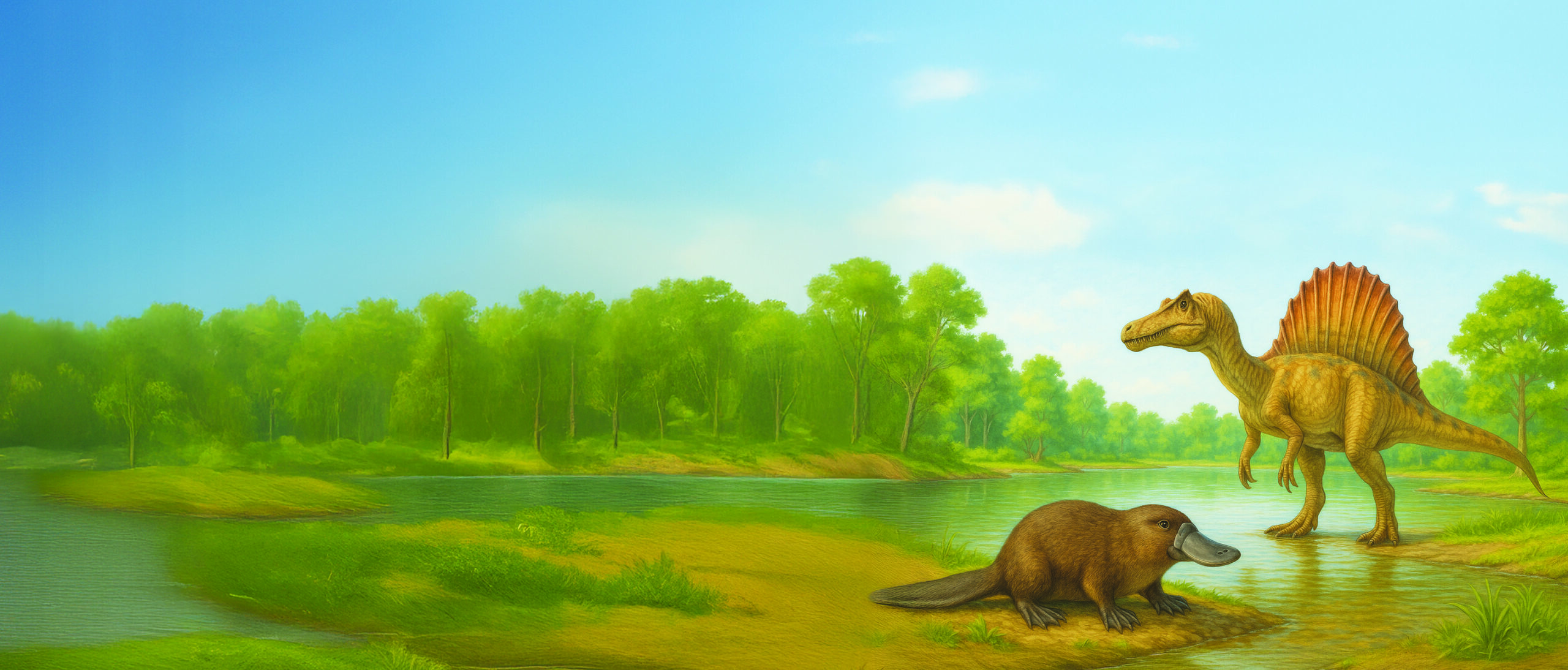
Platypuses and Dinosaurs: Evolutionary Enigmas
By Tom DeRosa, Executive Director of CSI.
Platypuses
One of the most perplexing, weird, and confounding creatures for biologists to understand—especially for evolutionists—is the Australian platypus. It’s also called the duckbilled platypus because it has a bill that looks like a duck’s, along with webbed feet, and that’s about all. Everything else is different and definitely not a bird. It does lay eggs, but its leathery, soft-shelled eggs are like those of a lizard.
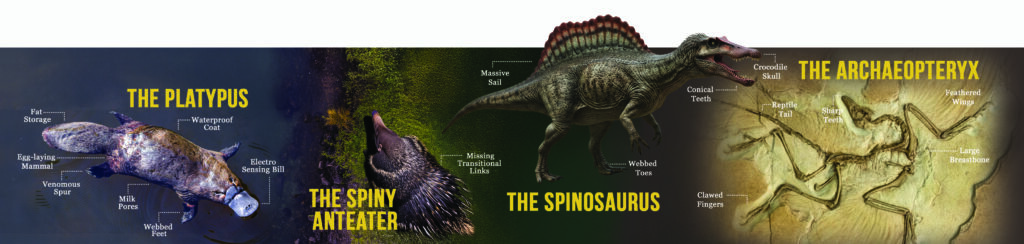
When you approach it, you can’t help but notice that it is covered with thick fur and has a wide, flattened tail like a beaver, which can act as a rudder, aid in nest building, and is primarily used for storing fat. Its coat is so dense (second only to the otter’s prized fur) and waterproof, allowing it to maintain a constant temperature both in water and on land. The fur is biofluorescent, and when ultraviolet light shines on it, it emits a bluish-green color for camouflage. The animal’s bill is not as hard as a duck’s but is as soft as skin, and it is used for hunting shellfish and other crustaceans. The bill contains 40,000 electroreceptors that help it accurately locate prey through motion and temperature changes, similar to those found in bottlenose dolphins, sharks, and rays. It often hunts with its eyes and ears closed underwater.
The platypus is found in eastern Australia and on the nearby island of Tasmania. This furry, semi-aquatic freshwater creature, measuring between 15 and 24 inches, weighing 1 ½ to a little over 5 pounds when fully grown, is one of the few mammals that lay eggs. It prefers to raise its young on land in tunnels it digs, and hunts in nearby streams and rivers. Unlike most mammals, which have nipples to feed their young, this mammal can secrete milk through its pores in a unique way. It also lacks a stomach to help digest and store its food, which consists of worms, insects, and crustaceans, so it must eat vigorously—about 30 percent of its body weight daily.
Despite its array of strange traits, this perplexing animal can surprisingly produce venom from its specialized crural glands. Similar to the sweat gland and located in the male platypus’s hind legs, these glands are connected to hollow tubes leading to the spurs located behind the animal’s ankles. The glands fill up during mating season and inject, via the spurs, toxic substances, making them one of the few venomous mammals, similar to reptiles, snakes, and some exotic fish. The venom, when delivered, is not fatal to humans but excruciatingly painful, making painkillers ineffective, and its effects last a long time. This unusual platypus venom is clear and slightly sticky, with a variety of compounds that can be found in snake venom.
The spiny anteater is the closest evolutionary relative to the platypus because, like the platypus, it is a mammal that lays eggs instead of giving live birth. Both the platypus and the spiny anteater are considered evolutionary enigmas because their transitional links are missing. They seem to have appeared suddenly with traits that are both mammalian and reptilian—in the case of the platypus, features like a duck’s bill, webbed feet, and fish electroreceptors. The platypus’s DNA confirms this oddity.
When European naturalists first reported the Australian platypus, it was hard to believe such a creature existed on Earth. This strange-looking animal, with its duck-billed beak, seems unnaturally attached to a small head with a brown, furry body. With its odd body and other bizarre traits, it’s no wonder the platypus has become popular in children’s literature. Its confused welter of duck, beaver, otter, and lizard traits, along with electroreceptors similar to those in some marine animals, as well as venom, which is typical of snakes, all made classifying this weird biological cocktail an enormous challenge for taxonomists. The discovery of an ancestor of the duck-billed platypus remains an evolutionary enigma, especially when, in 2008, its DNA analysis revealed genes similar to those of reptiles, mammals, and birds.
When this occurs in the biological world, the term “mosaic animals” is used to describe organisms composed of distinct components that come together to form a whole. This can also indicate that we might not fully understand the sovereignty of our Creator and the power He has over the creatures He spoke into existence in Genesis 1, when He used the phrase “after their (its) kind” ten times. Such emphasis should remind us that evolution is in direct conflict with God’s Word.
Bizarre Dinosaurs
A German paleontologist, Ernest Stromer (1871–1952), during his famous expedition to Bahariya, Egypt, in 1912, uncovered strange, huge vertebrae spines that seemed to jut into the air, accompanied by a lower jaw and teeth that resembled a reptilian-like dinosaur jaw. He named it Spinosaurus in 1915. Stromer’s fossil collection, which was destroyed during World War II, was the first to unveil dinosaurs found in Egypt. More Spinosaurus-type fossils were later discovered in Morocco, revealing that the vertebral spines could be as long as 5 to 7 feet, which suggested that this dinosaur had a strange sail-like structure that it likely used to strut around on land for all to admire.
The Spinosaurus sail remains an evolutionary mystery. There is a marine creature with a prominent dorsal fin: the sailfish. Its flexible sail provides stability when the fish travels at high speeds, making it one of the fastest fish. It also uses its sail to herd small fish when expanded, and it plays a role in sailfish communication. The Spinosaurus’s sail was massive because it was on the back of a giant terrestrial theropod (three-toed) dinosaur, measuring up to 59 feet long and weighing around 23 tons—bigger than any other, including T. rex and Giganotosaurus. Based on the fossils discovered so far, it is believed that the sail was at least somewhat rigid and may have been used for display or thermoregulation, but this remains speculation due to many unknowns.
In a 2014 National Geographic/Nova production titled “Bigger than T. rex,” paleontologist Nazar Ibrahim said, “The Spinosaurus is the most bizarre dinosaur out there… I feel like I am working with an alien from outer space. It is unlike any other dinosaur… But really, the most interesting thing for me was that it was the first dinosaur to take to the water.” Spinosaurus had a narrow, elongated skull similar to that of a crocodile, with matching conical teeth. It was very different from the curved, serrated teeth of carnivorous theropods. Like a crocodile, it had a long neck and a strong tail. In addition to these unique features, it had flat, spreading toes that some paleontologists believe could have been covered with skin, forming a web for swimming. When we try to classify Spinosaurus, we see a dinosaur with traits typical of large carnivorous theropods, but also notice a sail-like structure, as well as crocodile-like skull, teeth, and tail. In fact, many paleontologists believed it could swim in water like a fish. This definitely aligns with mosaic animals like the platypus, another evolutionary enigma.
Dinosaurs are fascinating creatures from the past that attract a lot of attention, especially from younger generations. They are bizarre creatures that represent mosaic animals that once roamed the Earth. When considering the paleontological evidence uncovered so far, the characteristics of these fossils range from an inherent mix of reptilian, avian, and mammalian traits, making their diversity even more remarkable. The Archaeopteryx is a prime example of a mosaic creature. Fossil evidence shows a combination of bird-like features, including a large breastbone, feathers, and feathered wings for flight, alongside reptilian traits such as teeth, claws, and a tail. The size of some of these animals, such as the sauropod, which stood four stories tall, and the theropods like T. rex and Spinosaurus, was immense, weighing tons. Their behavioral patterns, as studied in their fossilized tracks, suggest they were active creatures requiring higher metabolic rates, leading us to believe they were closer to mammals. This is evidenced by bone histology, oxygen isotopic data, and large respiratory cavities—all of which indicate complex breathing systems that meet their high oxygen demands. And that, in turn, suggests they were not reptiles but rather some warm-blooded animals.
Many questions remain unanswered, but we are witnessing an evolutionary enigma, much like the platypus—one lacking in transitional forms yet still astonishing in its bizarre nature. Call them “crazy uncles” in the so-called tree of life.
Evolutionists are trained not to make a connection to a sovereign God who governs the universe and breathed life into every creature. They blindly seek to make connections to their own foolish ideas that lead to destruction and death. “But God chose the foolish things of the world to shame the wise; God chose the weak things of the world to shame the strong” (1 Corinthians 1:27).

